AI Library Seal: The Quiet Upgrade in a Loud Digital World
AI Library Seal: The Quiet Upgrade in a Loud Digital World
Public libraries are in the middle of a subtle modernization wave: more digital circulation, more community programs, more document handling—yet the same need for clear ownership and accountability. In that shift, the humble library seal is getting a second life, and “AI library seal” has become shorthand for something very practical: using smart design assistance to generate consistent, readable seals for books, letters, certificates, and internal paperwork without slowing staff down.
This isn’t about flashy tech. It’s about making routine library operations—marking property, standardizing outbound documents, and keeping community materials organized—feel reliable in both print and PDF form. (Many institutions still depend on seals and stamps as recognizable signals in documentation workflows, even as those workflows move online.)2
Why library seals still matter
Walk into almost any library archive or back-office and you’ll find evidence of stamps everywhere: accession records, donation receipts, interlibrary loan forms, and “property of” markings tucked onto title pages. The seal’s job is straightforward—clarify where an item belongs, who processed it, and which branch or department is responsible when questions come up.
In a time when materials travel farther and faster (via interlibrary loans, community partners, pop-up reading rooms, and school collaborations), a consistent seal does more than deter loss. It reduces friction: staff can identify an item at a glance, and patrons know which library to contact when something gets misplaced.
Related: Browse library seal templates
What “AI library seal” really means
Most libraries don’t want a futuristic-looking emblem. They want a seal that prints cleanly, looks official without being intimidating, and stays consistent across teams—especially when staffing rotates or volunteers help with events.
“AI” in this context usually means design automation:
- Suggesting balanced layouts for circular or rectangular seals.
- Auto-adjusting spacing so long branch names still fit.
- Generating multiple variants (adult section, children’s section, archives, book sale, donations).
- Producing export-friendly files for both on-paper stamping and digital overlays.
In other words, AI is being used to remove repetitive formatting work—not to replace policy decisions, cataloging standards, or professional judgment.
Try it: Open the AI library seal maker
The modern library use cases
A library seal is no longer limited to the inside cover of a hardcover. Today, the same design often needs to work across:
- Print circulation: “Property of” marks, discard stamps, donation intake.
- Programs and events: workshop certificates, reading challenge completion sheets.
- Archives and special collections: provenance labels and processing notes.
- Digital documents: PDF letters, policy acknowledgements, internal approvals.
That last category is where tools matter most. Libraries increasingly need a seal that can be placed into a PDF cleanly—sharp lines, high contrast, and legible text even after compression.
How staff actually make seals now
Many teams start with whatever is fastest: a basic template, a quick search, or an old file someone emails around. The downside is predictable—five variations of the “same” seal, uneven typography, and inconsistent department names.
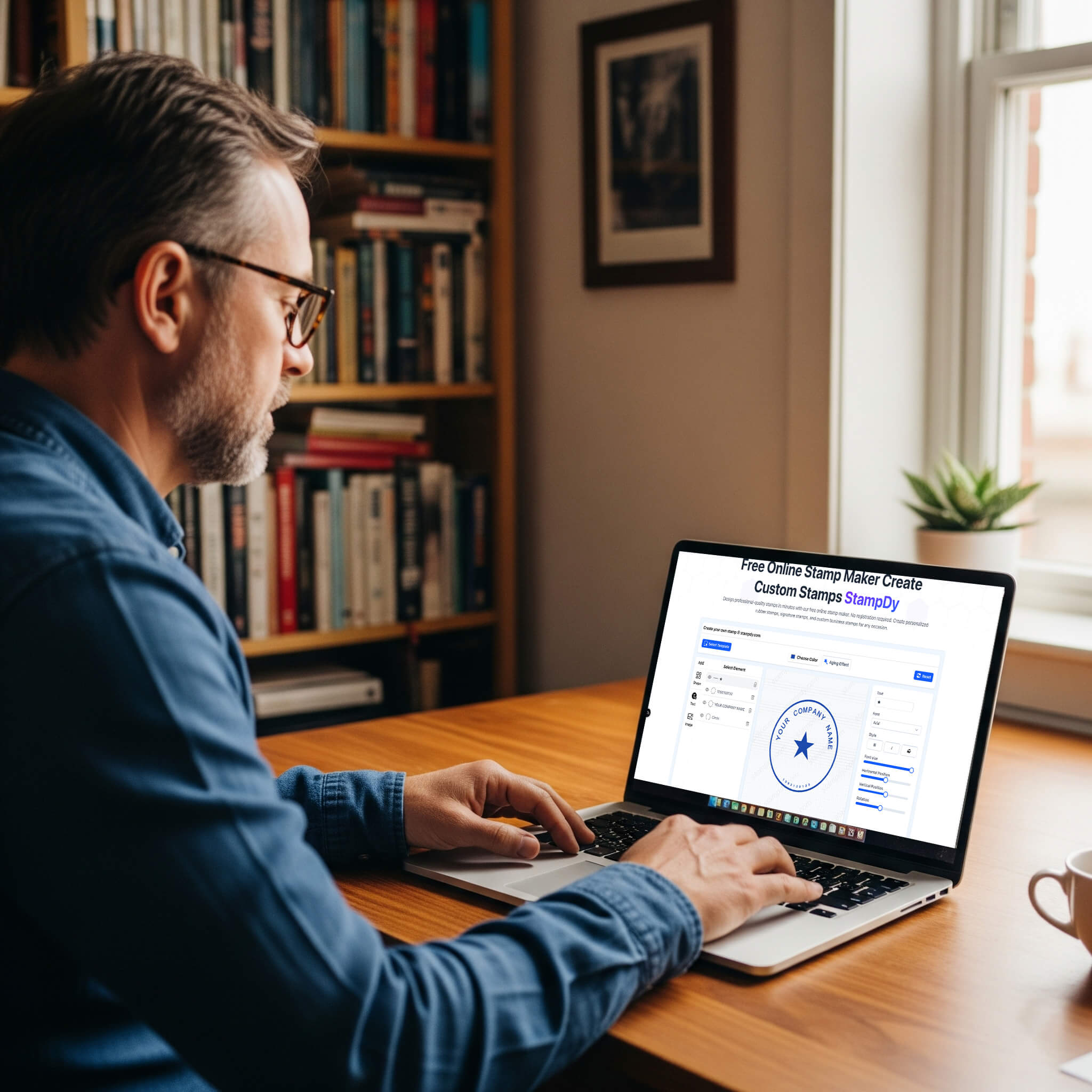
A better workflow (especially for multi-branch systems) is to standardize creation and exports through an online stamp maker, then keep one approved “seal kit” that staff can reuse for common tasks. When a librarian or admin assistant needs a new version—say, an outreach van seal or a summer program stamp—they can generate it with the same rules, rather than improvising from scratch.
This is where keyword searches like stamp maker reflect a real operational need: people aren’t looking for art, they’re looking for a repeatable process.
Keeping it official without overdoing it
Libraries occupy a unique space: they’re public-facing, trusted institutions, but they aren’t trying to mimic government seals or legal stamps. A good AI library seal tends to share a few traits:
- Simple geometry (circle or rectangle).
- High legibility at small sizes.
- Clear institutional naming (system + branch).
- Optional fields that support workflow (date line, staff initials box, department tag).
The goal is calm authority. A seal should look credible on a printed form and equally credible on a digital letter—without crossing into the visual language of legal notarization or state-issued marks.
Related guide: Everything You Need to Know About Date Stamps
A practical creation checklist (for print and PDF)
If the seal will live in both physical stamping and digital placement, design it like it will be photocopied ten times—because eventually it will be.
- Use thick enough strokes that don’t vanish when printed.
- Avoid tiny serif fonts for the outer ring text.
- Leave breathing room so ink bleed doesn’t swallow letters.
- Export a transparent PNG for documents and an SVG for scaling.
- Create two sizes: small (books/forms) and medium (letters/certificates).
If your team is experimenting first, a stamp maker online free option can be useful for trial layouts—just treat it as a prototype step, then lock an approved version for consistent use across the organization.
The governance piece: consistency beats creativity
The most common failure mode isn’t bad design—it’s uncontrolled variation. One branch adds “City Library,” another adds “City Public Library System,” a third shortens everything to initials, and suddenly your “official” mark looks unofficial.
A lightweight governance approach fixes this fast:
- One owner (operations lead, admin coordinator, or comms).
- One naming standard (system name + branch name).
- One file folder for exports (PNG/SVG, two sizes).
- One short rule: seals are for ownership/workflow marking, not legal certification.
That’s how a library seal becomes a tool instead of a style debate.
Why this topic is trending now
Libraries are being asked to do more with less: more partnerships, more digital materials, more accountability reporting. Small operational improvements—like standardizing seals and stamps—add up. And because seals sit at the intersection of physical and digital work, they’re an easy place to apply automation without changing core services.
That is the real story behind “AI library seal”: not a novelty, but a quiet upgrade that helps libraries stay consistent, recognizable, and efficient.