AI Stamp Generators: The Next Step Is Editable Constraints
The most useful future for AI stamp generators is a design that can be corrected without being reinvented. A convincing preview is valuable, but a business stamp also needs exact wording, stable geometry, and a file that another person can understand and revise.
That suggests a different direction from simply generating larger images: combine creative proposals with explicit constraints and editable components. Recent vector-graphics research gives reasons to watch this direction. It does not establish that an AI system can already produce reliable physical stamps without review. This outlook separates published research from a proposed way to judge future tools, as of September 27, 2026.
Two Research Signals Worth Watching
SVGThinker, submitted to arXiv on September 29, 2025, studies instruction-aligned text-to-SVG generation. The authors describe a process built around sequences of graphic primitives and report outputs that retain editable structure. The relevance to stamps is the representation: separate vector components offer a different starting point for correction from a single flattened picture.
DesigNet, submitted on April 7, 2026, focuses on SVG outlines with explicit control of curve continuity and axis alignment. Its authors introduce refinement mechanisms for joins and horizontal or vertical alignment. Those are geometric properties a designer can inspect; they are more specific than a general claim that an image looks professional.
Neither paper is evidence that a stamp will print clearly on a particular material. Nor do these papers establish that every company name will be reproduced correctly or that the methods are implemented in Stampdy. The connection to stamp work is an editorial inference: editable structure and controlled geometry could make certain corrections easier to specify and verify.
Research should change the questions we ask, not remove the need to ask them. “Does this generate SVG?” is only the beginning. What is inside the SVG, and which parts remain independently editable?
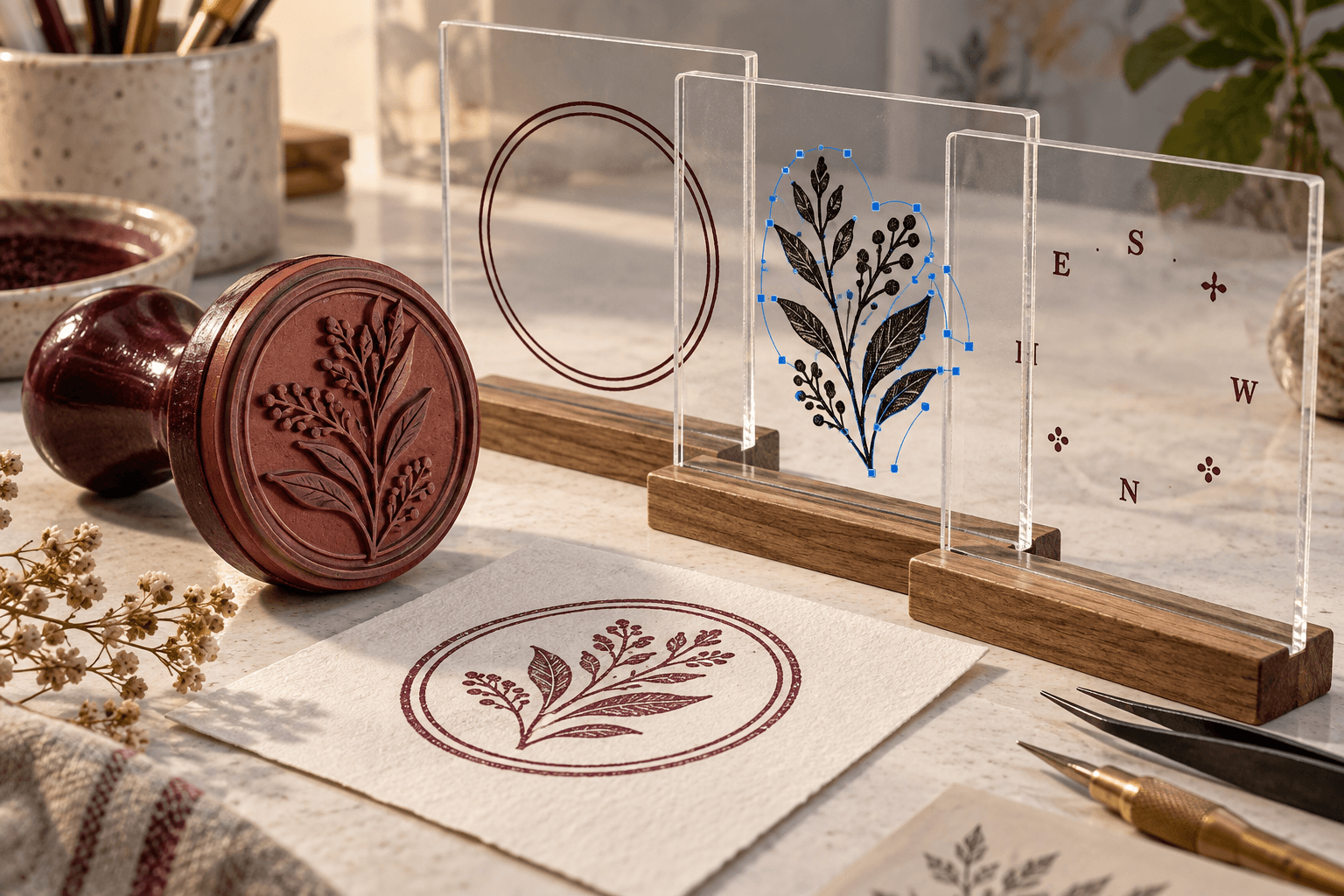
AI-generated concept illustration of separated artwork components. It does not depict a current application or a working research system.
Future Stamp Generators Need Hard Rules and Creative Freedom
Some design choices are negotiable. Others are not. A botanical emblem can have several acceptable arrangements; a required registration number cannot have several approximately correct versions.
A useful future interface would separate these two kinds of input. Hard constraints might include the exact text string, outer dimensions, required content, and elements that must remain fixed. Flexible preferences might include visual mood, decorative density, or the arrangement of a nonessential ornament.
For example, consider the hypothetical instruction: “Keep the supplied name and circular border unchanged; propose a simpler leaf in the center.” A result that improves the leaf but changes a letter has failed the task. The unchanged items are part of the acceptance condition, not background context that the model may reinterpret.
That distinction also creates a sensible division of labor. Deterministic text and layout controls can preserve exact input while a generative system proposes alternatives for the flexible portion. This is a proposed product direction, not a statement that today's tools all follow that architecture.
Do not assume that a longer prompt creates a hard constraint. A tool must demonstrate that it can preserve the requested element across edits. The evidence is in the resulting artifact and the revision behavior, not in the confidence of its explanation.
Editable Means More Than Having an SVG Extension
There are several levels of editability. An SVG containing a bitmap is a container around a picture. An SVG containing paths can expose outlines. A design with separately identified text, border, and logo components can support a more meaningful revision. Those are different deliverables even if their filenames end the same way.
Text introduces another distinction. Letter outlines may be editable as shapes without remaining editable as a word. Changing a path point is not the same operation as correcting “STUDOI” to “STUDIO.” A useful tool should explain which kind of edit the user can actually make.
For future stamp systems, a strong demonstration would show one constrained change followed by an inspection of the parts that should not have changed. Remove a leaf, move a date line, or increase a border gap. Then compare the exact wording and untouched shapes with the earlier version.
If a tool can only regenerate the entire mark, treat it as a concept generator for that task. That may still be useful. It simply should not be described as precise local editing without evidence.
For present-day work, Stampdy's AI image stamp maker provides an image-based starting point, while the regular stamp editor offers a separate route for native text and layout control. Do not infer an automatic conversion from generated pixels into fully editable editor elements.
A Five-Task Evaluation for the Next Tool You Try
The following is a proposed evaluation protocol, not a published benchmark or a report of tests already conducted. Use examples you have permission to share, preserve the original inputs, and keep failures as well as attractive results. The purpose is to discover what kind of work the tool can support.
Task 1: Preserve an exact string
Supply a short name containing repeated letters, a number, and punctuation relevant to your real work. Record the required characters separately. Check the result one character at a time, including order and spacing where spacing carries meaning.
Do not accept a nearly matching word because it looks plausible in an arc. Record whether the correction can be made directly, whether it requires regeneration, and whether the corrected result introduces another error. The effort needed to obtain exact content is part of the evaluation.
Task 2: Change one component only
Ask for a small alteration to a central symbol while preserving the border and text. Compare the result with the original at the same size. Note any movement, shape change, or character substitution in the protected components.
This tests whether a local-edit promise has a practical meaning. A beautiful new composition does not count as success when the requested task was to preserve most of the old one.
Task 3: Inspect the delivered structure
Open the delivered file in a compatible editor. Determine whether it contains a bitmap, independent paths, editable text, or a mixture. Try selecting the border without selecting the whole stamp.
If the file is SVG, Stampdy's SVG-to-stamp workflow is one possible place to inspect and work with a supported design. Successful import does not itself certify production suitability. Record what can be edited, not just whether the file opens.
Task 4: Introduce a physical size constraint
Choose an intended size before generating the design. Inspect the output at that size rather than at a large screen zoom. Identify the narrowest gaps and smallest essential characters. Ask whether the tool exposes dimensions clearly enough to repeat the evaluation.
Do not invent a universal minimum line width for every rubber, ink, or production method. A physical maker must assess those limits for the actual process. The question for the AI tool is whether its design can be evaluated against a known requirement.
Task 5: Recover from a rejected result
Deliberately reject one specific feature: an extra star, an unwanted texture, or a crowded line. Ask for its removal while keeping the accepted parts fixed. Count the revisions in your own record, but do not generalize a single trial into a reliability percentage.
This task examines the part of design work that polished demonstrations often omit. A tool is easier to judge when you see how it responds to a correction, not only what it produces from a fresh prompt.
Physical Feedback Is a Separate Problem
Even a structurally clean file does not prove a clean ink impression. Paper texture, ink behavior, pressure, and the manufactured plate belong to a physical process. An on-screen check can help identify a questionable gap; it cannot establish how that gap survives every real combination of materials and use.
One plausible future direction is a design assistant that flags potentially fragile details against a maker-supplied profile. Such a system would need to disclose what process the profile represents and what has actually been validated. A warning based only on image appearance should not be presented as a manufacturing certificate.
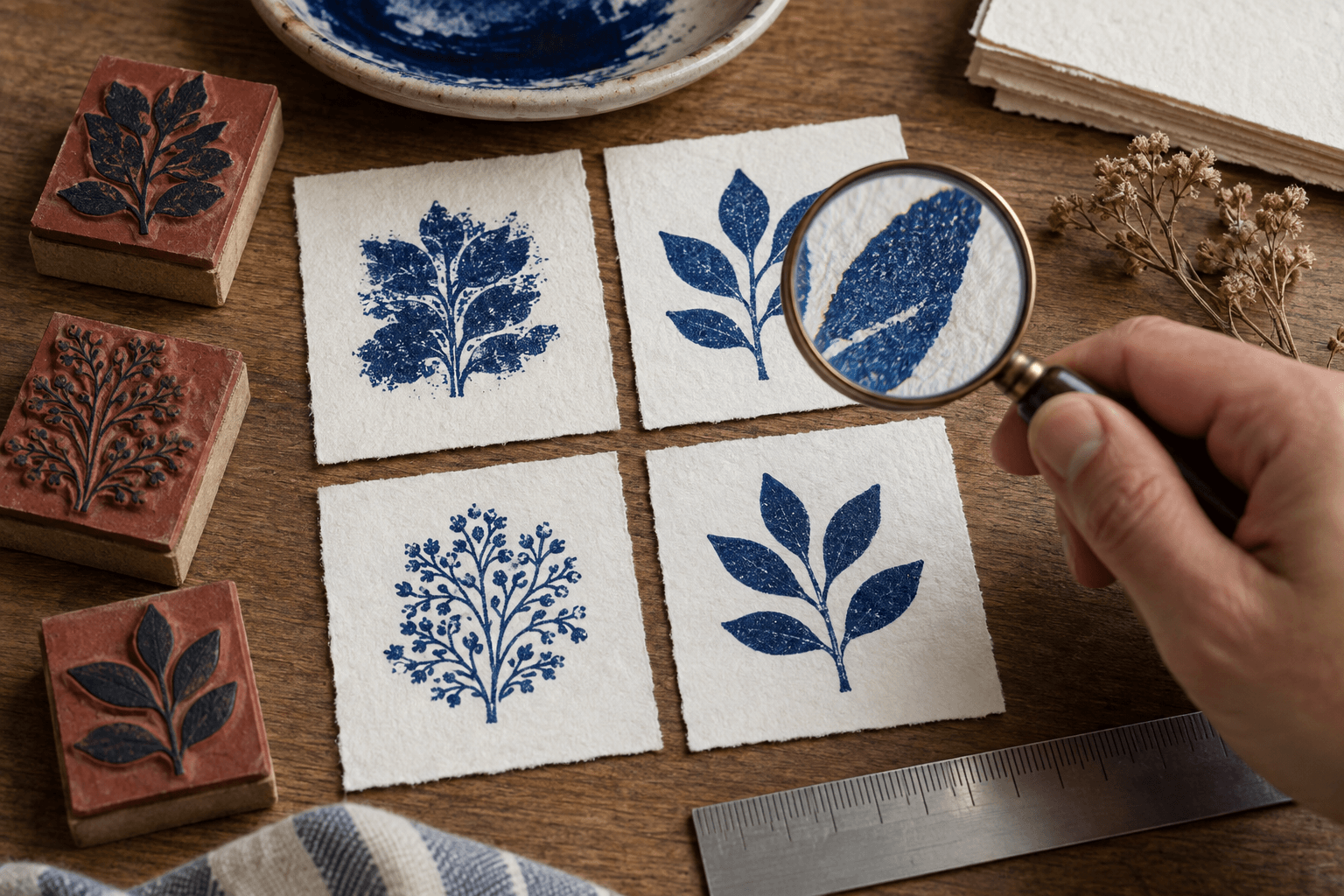
Generated comparison scene, not experimental evidence. It illustrates why the printed mark requires its own evaluation.
For now, keep digital and physical observations in separate columns. “The file has independent paths” is a digital observation. “The smallest opening remained clear in this sample impression” is a physical observation. Neither should silently stand in for the other.
What Is Plausible, and What Remains Uncertain?
A practical future workflow could begin with creative alternatives, preserve chosen components, permit deterministic corrections, and finish with process-specific checks. The appeal is that different tools handle different kinds of uncertainty: generation explores possibilities; text controls enforce wording; a maker validates manufacture.
That direction does not require every operation to use AI. A predictable alignment control may be a better solution than regenerating a stamp to move one line. Useful automation should reduce the unresolved work, not merely hide it behind a new preview.
The uncertain parts include reliability on unfamiliar lettering, useful structure in complex logos, behavior under repeated revisions, and the quality of physical-process feedback. The cited research does not establish deployment dates or answer all of those questions.
Before adopting a new tool, ask what artifact you receive, which parts remain editable, how exact content is preserved, and what happens when a local correction fails. If the answers are vague, limit its role to the stage you can verify.
Frequently Asked Questions
Will AI-generated SVG automatically be ready for engraving?
No. Inspect the contents, intended dimensions, and smallest details. A vector representation can support editing without meeting a particular maker's production requirements. The physical process still needs an appropriate review and, when relevant, a sample impression.
Do the cited papers describe features available in Stampdy?
No integration is claimed here. They are research signals used to discuss a possible direction for stamp design tools. Stampdy's current image-generation and regular editing workflows should be judged by their actual controls and outputs, not by features described in an unrelated paper.
Should I postpone a stamp project until these tools improve?
If you can complete the current job with verified controls and a suitable production check, there is no need to wait for an unspecified future capability. Keep exact content in a form you can correct, and use generative tools only where their output can be reviewed adequately.
Conclusion
Judge the next generation of stamp generators by the corrections they permit, not just the previews they produce. Bring an exact-text task, a local edit, and a file-inspection test to your evaluation. A tool earns a larger role when it preserves the constraints you can verify; physical production remains a separate claim to demonstrate.