Buying a Stamp Online: September 2026 News That Matters
A familiar stamp appearing in a different-colored case does not necessarily need a new design file. A redesigned ink cartridge, however, deserves a compatibility check. If you are buying a stamp online, the useful question behind a product announcement is what actually changes: the housing, the consumable, the impression, or the way the maker produces it.
This review covers selected manufacturer announcements checked on September 27, 2026. The freshest items concern COLOP's Mini housing transition and Trotec's Black Line launch events; earlier Trodat updates provide useful context for replacement parts. These are regional or product-specific notices, not evidence that every stamp supplier has changed its stock.
Read Stamp Online News by the Part That Changed
A stamp listing can show several different things in one photograph. The plastic housing is what you hold. The text plate carries the design. The ink pad supplies the color. The paper impression is the result. Treating those as one specification makes a small catalog change unnecessarily confusing.
Before comparing a new listing with your old order, separate the information into four lines:
- Exact stamp model or housing reference.
- Impression width and height, plus the approved wording or artwork.
- Ink color and the intended surface.
- Replacement pad or other consumable reference.
This is a suggested buying method, not a manufacturer's compatibility rule. Its value is that a changed photograph cannot silently replace a recorded requirement. A black housing and black ink, for example, are different choices. Neither tells you whether the design inside is the one you approved.
For a reorder, keep the old model reference available even if the supplier says a newer version has replaced it. Ask which part of the order transfers unchanged. A supplier's answer about the complete stamp should not be treated as an answer about every replacement component.
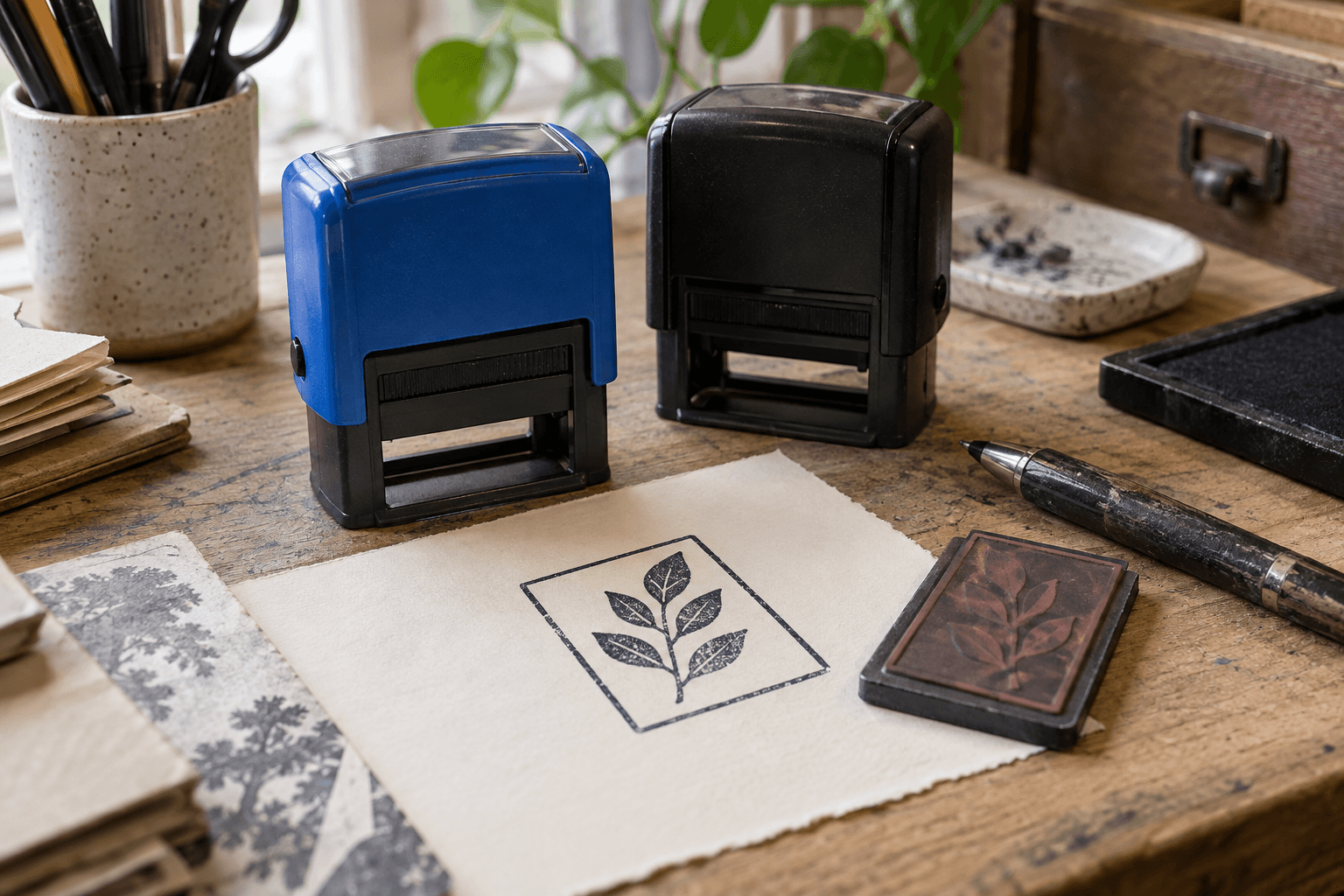
AI-generated editorial illustration: exterior color and printed artwork are separate specifications. These are not photographs of the announced products.
September 18: COLOP Mini Changes Its Housing Color
COLOP Polska announced on September 18, 2026 that blue Mini housings would gradually be replaced by black housings as existing stock sold through. The notice says both colors may appear during the transition, depending on availability, and describes the change as cosmetic, with the products' purpose and functionality unchanged.
For a buyer reading that regional announcement, the immediate implication is modest: a different case color is not, by itself, evidence of a different stamping function. The announcement also does not establish what any particular reseller will ship today.
If appearance matters because several people share a desk, put the requested case color in the order notes. If appearance does not matter, concentrate the confirmation on the model, imprint, and ink. That prevents a cosmetic preference from becoming confused with a requirement for the mark on paper.
Consider a hypothetical reception desk that identifies its address stamp by a blue case. A black replacement might be perfectly acceptable for the task but less obvious to the person looking for it. The remedy could be a labeled storage position or a clear imprint sample beside the stamp. Redesigning the address artwork would not solve that identification problem.
Nothing here requires discarding a functioning old stamp. Decide whether the existing unit still does the job, then determine whether you need a new complete stamp, a consumable, or simply clearer identification. The news tells you why a listing may look different; it does not make the purchasing decision for you.
Earlier Trodat Updates Show Why Part Numbers Still Matter
Trodat France's May 7, 2026 news entry announced that 6/4929 ink cartridges were moving to the 4.0 design with grip tabs ahead of the Printy 4929 launch. Its July 3 entry separately described additional pastel Pocket Printy references. One notice concerns a consumable design; the other concerns a product range's appearance choices.
Those short announcements should not be expanded into a blanket promise of interchangeability. When you need a replacement cartridge, ask the supplier to confirm the exact housing and cartridge combination. Similar dimensions in a photograph are not a substitute for that confirmation.
There is a useful distinction between asking, “Is this the new version?” and asking, “Will this replacement pad work in my exact model?” The first question can receive a correct answer that still leaves your practical problem unresolved. Include the model reference and a photograph of your existing component when a supplier requests one.
A pad order and an artwork order also need different evidence. For the pad, identify the component and required ink. For a new text plate, identify the final impression size and design. If you have been asked to approve artwork, the stamp proof sheet guide explains how to make that approval specific enough to use.
Do not use a replacement-parts announcement as a reason to redraw a logo. Equally, do not use an unchanged logo as evidence that a new mechanical part fits. These checks belong to different parts of the purchase.
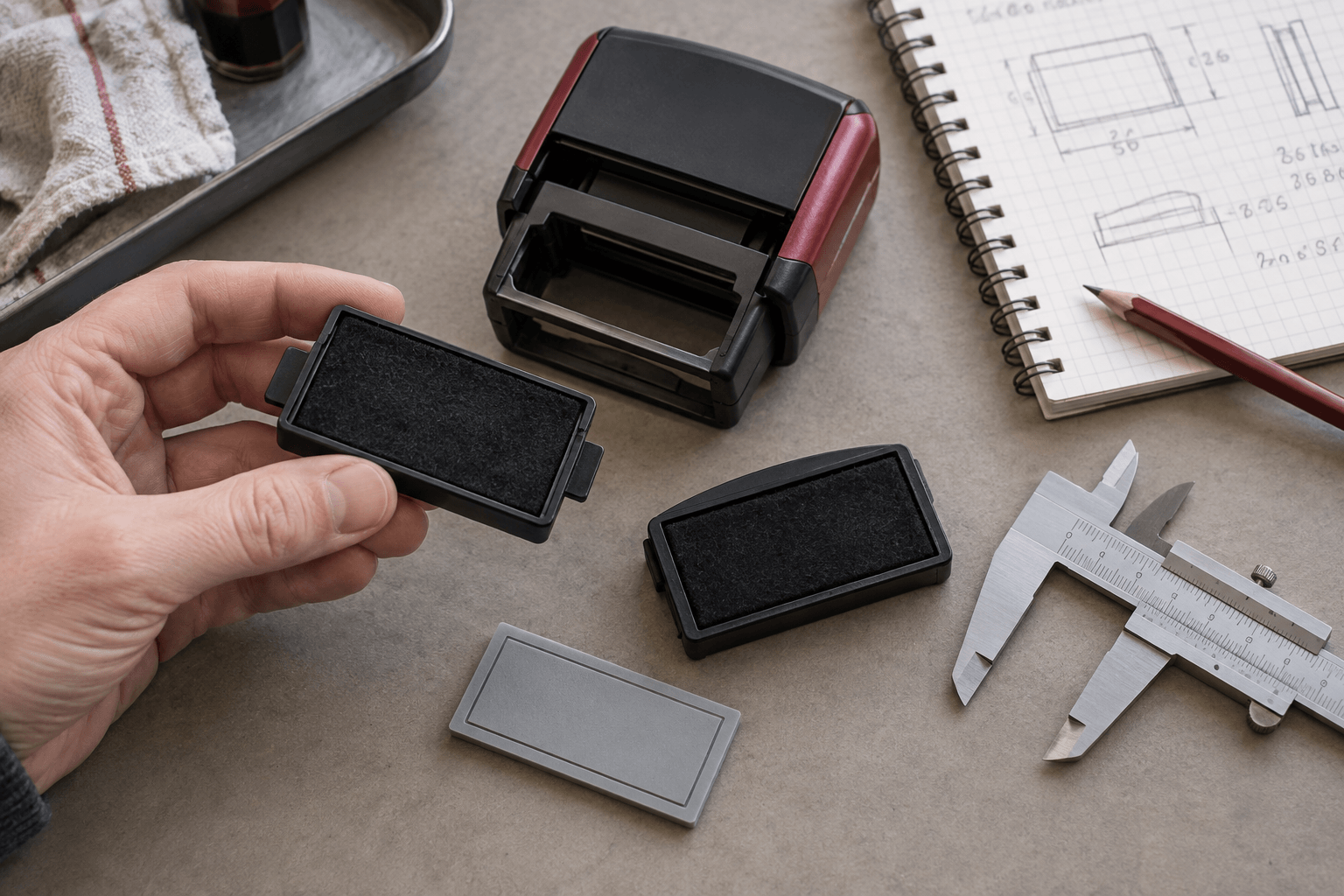
Illustrated component-inspection scene, generated for this article. It does not establish compatibility between real products.
September 21: A Laser Launch Tour Offers Questions, Not Proof
Trotec's September 21, 2026 newsroom update described a global Black Line launch tour involving demonstrations, customer events, webinars, and other sessions. The published schedule included September events and further planned dates in the following months. An announced future demonstration should not be reported as one that has already happened.
For a business that orders stamps, this kind of production news is one step removed from the finished product. A supplier may use different equipment from the machine in the announcement. Even a supplier with the new platform still needs to demonstrate that your design can be made at your requested size.
For a stamp shop considering equipment, a demonstration is an opportunity to bring a representative job. A decorative sample selected for a launch can show a machine's possibilities without answering the difficult questions in your own workload.
Useful demonstration requests include a small text plate, a design with tight interior spaces, and a repeat of an earlier job. Ask to see the input artwork, the prepared production job, and the resulting impression. If elapsed time matters to your business, define where timing starts and ends before comparing anything. File preparation, cleaning, and mounting are not the same as the machine's processing interval.
This is an evaluation proposal, not a reported test of Black Line. No performance improvement for a particular stamp order can be concluded from the event notice alone.
A Reorder Example: Keep the Decision Narrow
Imagine that you need a second address stamp for a packing bench. The online listing now shows a black case, the supplier mentions a revised cartridge, and your team wants to shorten one line of text. Those are three separate changes, even though they arrived in the same email.
First, decide whether the second stamp must produce exactly the same mark. If the wording is changing, it is a revision, not an identical reorder. Give the revised file a distinct name and keep the earlier impression available for comparison.
Second, confirm the housing and pad references. Do this independently of the artwork review. A supplier should not have to infer which part you want from the color of an attached screenshot.
Third, check whether the shorter wording affects visual balance. An unchanged border can look too large around a reduced line. That is a layout judgment rather than a reason to change the housing. The guide to stamp border spacing addresses the space between lettering and its frame.
Finally, send one approved design and one concise order description. Avoid attaching several near-identical drafts without identifying the selected one. If you are still deciding on the lettering, use the Stampdy stamp editor to prepare the visual design, then have the physical maker confirm the production requirements. Designing the artwork does not place an order for hardware.
Ask for the Information the Announcement Leaves Out
Manufacturer news is written to introduce a change. Your supplier has to connect that change to an actual order. A useful inquiry might read:
“Please confirm the housing model, impression size, ink color, and replacement-pad reference for this order. Is the case color selectable or dependent on stock? Does the attached artwork require any adjustment for your production method? Please identify any substitution before making the stamp.”
Adapt that wording to what you are buying. For a cartridge alone, omit artwork questions. For a digital stamp image, hardware questions are irrelevant. For an identical repeat order, state that no content revision is authorized.
Also distinguish availability from dispatch. A manufacturer announcing a product, a regional catalog listing it, and your supplier having it ready to ship are separate facts. If a deadline matters, obtain the supplier's current estimate for your order rather than borrowing a date from a news story.
Frequently Asked Questions
Should I wait for a new housing version before ordering?
Only if the changed feature matters to your use. If you need a particular case color or component, confirm current stock. A cosmetic update is not automatically a reason to delay an otherwise suitable stamp, especially when the intended impression is unchanged.
Does a product announcement mean my existing artwork is obsolete?
No. Check whether the actual impression area or production requirements have changed. A housing-color notice does not establish either. Keep the approved artwork until the maker identifies a concrete reason to revise it, such as a different usable area.
Can I approve the design using the product photograph?
A housing photograph normally does not show your exact wording, spacing, or final-size impression. Request a proof of the actual artwork. Review the text character by character, then inspect the layout at its intended size rather than judging only an enlarged preview.
Conclusion
The useful lesson from this September's stamp online news is to identify the changed part before changing your order. Record the model, impression, ink, and consumable separately. Ask your supplier to resolve the specific uncertainty, and revise artwork only when the intended mark or confirmed production requirement has changed.